Jar control
Spacing, guide contact, anti-rotation and transfers must keep the container stable without damage. Empty and filled behaviour can be different.

The correct automation level is the one that removes the real production constraint while preserving closure quality, safe operation and practical changeover. Compare the complete operating method rather than choosing from a headline speed alone.
Use production evidence. Final machine selection and acceptance depend on representative jars, lids, process conditions and agreed checks.
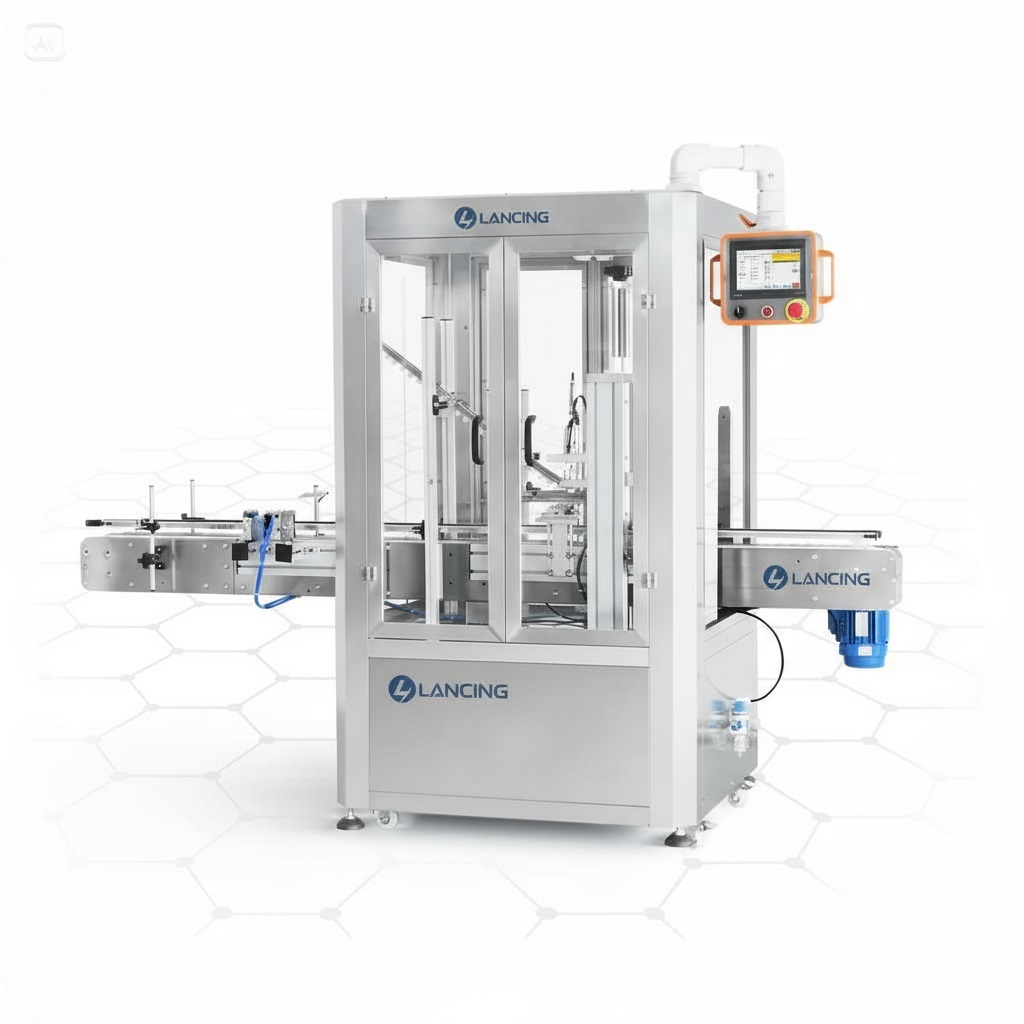
“Manual”, “semi-automatic” and “automatic” describe different divisions of work between the operator and the machinery. The useful comparison is the whole cycle from jar arrival and lid presentation to finished-pack inspection.
| Route | Typical operator role | Machine contribution | Main evidence needed |
|---|---|---|---|
| Hand-assisted or manual | Positions the jar and lid and performs most of the application cycle. | A hand tool or simple fixture may reduce effort or improve repeatability. | Operator method, ergonomics, approved closure check and batch demand. |
| Semi-automatic | Usually loads or presents the jar and pre-places the lid, then initiates the cycle. | Controls the tightening or closing action and supports repeatable setup. | Jar and lid samples, cycle sequence, torque or seal method and realistic staffing. |
| Automatic | Replenishes components, monitors the line, completes checks and responds to stops. | Controls jar handling, lid delivery or placement, capping and coordinated discharge. | Sustained line rate, format matrix, feeder behaviour, interfaces and fault recovery. |
A hand-assisted method can suit very small batches, development work or a wide range of infrequent formats. It remains dependent on operator technique, fatigue, access and the time needed to verify each pack. The business should define whether the purpose is simply to reduce effort or to improve a measurable closure result.
Record the approved method, tool setting where applicable, jar support, lid start position and inspection step. If output is limited by repetitive hand tightening, or if results vary between operators, a semi-automatic jar capper may be a more controlled next step.
Semi-automatic machinery often fits batch production where automatic lid feeding would add more complexity than the run pattern justifies. It can also be useful as an intermediate step before a full line is available. The operator’s loading sequence, reach, safe access and ability to maintain the expected cycle must form part of the assessment.
A representative trial should include normal format variation and a sustained run, not only a few successful cycles. Agree how mis-started lids, unstable jars, product on the finish and marginal torque or seal results will be handled.
Spacing, guide contact, anti-rotation and transfers must keep the container stable without damage. Empty and filled behaviour can be different.
Bulk loading, orientation, track capacity, chute delivery and placement must be proven with the actual closure family and accepted surface finish.
The capper must coordinate with upstream and downstream equipment, manage starvation and blockage, and recover predictably after routine stops.
An automatic solution is justified when it delivers the required good-pack output under agreed production conditions. Use the sustained-output guide and the FAT, SAT and commissioning guide to define that evidence.
Send a format matrix, batch pattern, current labour method, target good-pack rate, floor layout, utilities, production samples and examples of acceptable and failed closures. Lancing can then compare the practical route rather than assuming that more automation is always better.
Request an automation-level reviewNo. Automatic machinery is most useful when the format range, lid supply, line interfaces and sustained demand justify it. Flexible batch work may be better served by a controlled semi-automatic route.
It can provide a more repeatable application motion, but the result still depends on the jar, lid, setup, operator loading and the agreed test method. Samples and acceptance checks are required.
Output is useful only when the basis is clear. Compare good jars over a representative run that includes normal replenishment, stops, checks and changeovers.
Common triggers include sustained demand, repetitive labour, inconsistent lid placement, the need for line integration, and a stable format range that can justify automatic feeding and handling.
Yes. A business may retain a flexible semi-automatic station for short runs while using an automatic line for stable high-volume formats, provided the quality methods are aligned.
Send your jar, lid, product and target output. Lancing will help you identify a practical machine route and the samples needed for confirmation.